
 ROTARY DRUM SCREEN FOR WASTEWATER TREATMENT
We manufacture rotary drum screens from acid-resistant stainless steel, equipped with a drum made of perforated or slotted sheet and a system of rotating brushes. We select the screen opening size according to the type of contaminants to be retained, within the range of 1 to 20 mm, while the size of the unit is adapted to the required capacity of the installation.
The SOS-1 model has dimensions of 1620 × 850 × 670 mm, a motor power of 0.12 kW, a DN 150 inlet connection and a DN 200 outlet connection. For municipal wastewater, its capacity is 25 m³/h.
The rotary drum screen is designed for the mechanical separation of solid contaminants from wastewater and water. It can be used, among other applications, in wastewater treatment plants receiving diluted wastewater from combined sewer systems and in industrial installations as part of equipment selected for wastewater treatment and pre-treatment.
Screens of this type can be used in sugar factories, breweries, meat processing plants, poultry and fish processing facilities, fruit and vegetable processing plants, tanneries, textile plants, as well as in the paper and wood industries. Depending on the installation arrangement and the type of contaminants, an alternative solution may be a vertical screw screen.
We manufacture the unit from acid-resistant stainless steel. The main working element is a rotating drum whose screening surface is made of perforated or slotted sheet. The selection of the opening size allows the screen to be adapted to the contaminant fractions present in a specific installation.
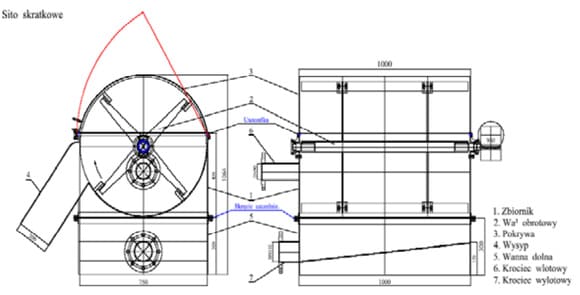
The rotary drum screen includes, among other components:
Wastewater is pumped into the interior of the drum. The liquid passes through the screening surface, while solid contaminants are retained on it.
Four rotating brushes operate inside the drum. They clean the screening surface and move the retained contaminants out of the drum into a collection container. This provides a self-cleaning screening process and reduces the need for manual cleaning of the working surface.
The collected solids are periodically removed from the container by the operator, while the treated wastewater or water flows into the lower collection tray and is then discharged from the unit.
| Parameter | Value |
|---|---|
| Type | SOS-1 |
| Capacity – municipal wastewater | 25 m³/h |
| Length (A) | 1620 mm |
| Width (B) | 850 mm |
| Height (H) | 670 mm |
| Motor power | 0.12 kW |
| Inlet connection | DN 150 |
| Outlet connection | DN 200 |
| Screen opening range | 1–20 mm |
The rotary drum screen operates in an enclosed and automatic system. We select the unit size and screening surface opening according to the installation parameters, flow rate and type of contaminants present in the wastewater.
As a manufacturer of wastewater treatment equipment, we also offer installation and commissioning of the rotary drum screen. We provide operator training and supply technical and operating documentation (DTR) in Polish.
Русский


 Polski
 Русский