
 SLUDGE MIXERS FOR SLUDGE HYGIENISATION IN WASTEWATER TREATMENT PLANTS
We manufacture sludge mixers designed for mixing dewatered sludge with a hygienising agent such as lime, fly ash or another additive used in the hygienisation process. The units are manufactured from acid-resistant stainless steel, while their enclosed construction helps reduce dust emissions during operation.
Depending on the required capacity, we offer versions with capacities of up to 2 m³/h and up to 8 m³/h. The system can operate independently or in fully automatic mode together with a sludge dewatering station, as part of a sludge hygienisation system and as part of the wider equipment for a new or modernised wastewater treatment plant.
The sludge mixer is designed for intensive mixing of dewatered sludge with a hygienising agent. Material is fed into the unit through two separate feed openings – the hygienising agent is introduced through one, usually by means of a screw conveyor, while dewatered sludge is supplied through the other.
Both components are thoroughly mixed inside the mixer chamber. After mixing, the prepared mixture is discharged from the unit and can then be directed for further conveying or to a storage area.
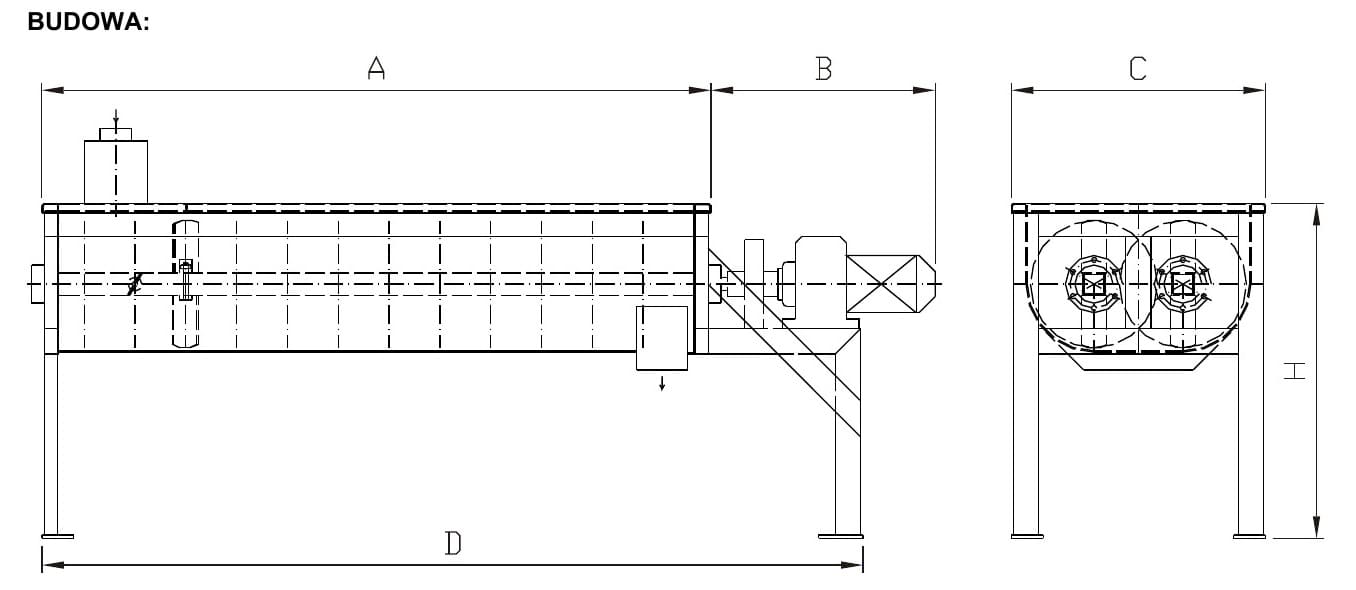
We manufacture the unit from acid-resistant stainless steel. The mixer has an enclosed construction, which helps reduce dust emissions and improves the operating conditions of the installation. Inside the mixing chamber there are two bearing-mounted shafts fitted with mixing blades.
Depending on the version, the shafts are driven either by two separate geared motors or by a single drive coupled through gears mounted on the mixer body. Above the feed opening we also install an inspection window, allowing visual monitoring of the hygienising agent dosing process.
The hygienising agent is supplied through the first feed opening, while dewatered sludge is introduced through the second. Inside the mixing chamber, two counter-rotating shafts fitted with blades intensively mix both components to produce a homogeneous mixture.
After hygienisation, the treated sludge leaves the mixer and can be directed for further conveying. The quantity of hygienising agent can be controlled by a cooperating dosing system integrated with the other equipment in the installation.
We control the mixer by means of a control cabinet integrated with the other equipment forming part of the sludge hygienisation system. This allows the system to operate in manual or automatic mode and to work directly with a sludge dewatering station.
This solution makes it possible to synchronise mixer operation with the dosing of the hygienising agent and the removal of the prepared mixture.
| Parameter | Version 1 | Version 2 |
|---|---|---|
| Capacity | up to 2 m³/h | up to 8 m³/h |
| Motor power | 1 × 1.5 kW | 2 × 2.2 kW |
| Weight | 450 kg | 600 kg |
| Dimension A | 2000 mm | 2000 mm |
| Dimension B | 750 mm | 800 mm |
| Dimension C | 750 mm | 1100 mm |
| Dimension D | 2000 mm | 2500 mm |
| Dimension H | 1050 mm | approx. 1150 mm |
As a manufacturer, we select the mixer parameters according to the capacity of the sludge hygienisation system and the type of hygienising agent used. This allows us to adapt the mixer both to systems operating with conveyors and to automated process lines integrated with a sludge dewatering station.


 Polski
 Русский